Folklore
"Folklore of the Region of Murcia"
 ---
--- ---
---
Crews - Female suit huertano - Male suit huertano - Typical recipe Murcia
Cuadrillas

The ´cuadrillas´ are part of our folklore. They are musical groups that sing together going from one house to another, playing the guitar, the lute,
the tambourine and the violin. The most famous are ´Cuadrillas´ from Barranda and Aledo. At Christmas and on some special occasions they also sing with people from different villages.
Here is an example of a traditional song:
"Esta casa es de oro Y los balcones de plata La gente que hay dentro Que pase felices pascuas”
“Esta noche es Nochebuena Y mataremos el pavo Le acercaremos las plumas Al vecino más cercano”
“A esta casa hemos llegado Cuatrocientos en cuadrilla Si quieres que nos sentemos Saca cuatrocientas sillas"
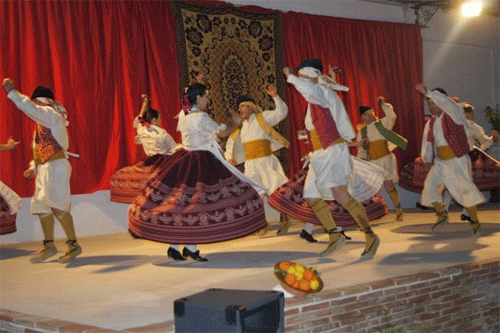 Another example of folklore are Singing and Dancing Groups, responsible for keeping the traditional dances.
They are very beautiful and "moved. The best known are the ´parranda´ and the murcian ´jota´. In summer there are many festivals where you can go and have fun.
Another example of folklore are Singing and Dancing Groups, responsible for keeping the traditional dances.
They are very beautiful and "moved. The best known are the ´parranda´ and the murcian ´jota´. In summer there are many festivals where you can go and have fun.
Female suit huertano

El Refajo: If anything defines folk costume of women in Murcia is the skirt, commonly called Refajo.
In cold areas of the Region of Murcia women used to wear woolen petticoats. However in warm areas the material was cotton this garment was made.
You can describe some features that differentiate some of these items:
List Refajo
It is a petticoat with vertical stripes of about 3 cm in width
Even the figure of a silkworm in petticoats are embroidered.
Sequined underskirt
The virtuosity in the details and ornaments are taken as an example of the moneyed classes.
Refajo cuts
Other ornamentation, more restrained, cuts were superimposed black velvet over pink silk fabric.
 El corpiño:
It is a kind of corset. Equivalence is the bodice. No porta sleeves, and placed on her blouse. The closure is achieved by a cross cord passes through eyelets on the front.
Camisole or shirt:
This is an article that originally was treated as intimate apparel. One of the most popular costumes original notes was represented in style. They were possibly some embroidered Moors.
Since the fifteenth century has written on various types of shirts, including:
Shirts Labradas:
were named for their embroidery. They were found in the wardrobes of Isabel the Catholic.
Shirts Listed :
less rich, the only ornaments were ribbons of different colors sewn fabric.
White was the natural color of the fiber shirt. At first they were made in short sleeves above the elbow. During the summer, in hot areas,
They get along without a bra. They also performed long sleeves, lace cuffs terminated.
 Apron:
This is a similar to the current one, which stood above the petticoat garment. They abounded silk, although it depended on the quality of the suit.
The most common are satin embroidered with sequins and rhinestones, knotted at the waist woman with great shoemaker whose tips, uneven loop
They used to embroider and arranged on the left side of the waist.
Other aprons, later, were produced in fine linen fabrics adorned with green beans, entredoses, tucks, etc.
 Pouch:
It was kind of a bag or pouch. It was fastened at the waist with cotton ribbons, and used the money saved on it and some useful everyday.
You could recharge with all kinds of ornaments.
A bag with his pocket money saved used under the skirts, or on them under the petticoat.
 Mantle:
The mantle was used at first against the cold, but ended up being a piece of ornament, decorative, you could even differentiate social classes.
Manila shawl
The origin of the Shawl is castizo not Murcia. But in the Region of Murcia it was used since 1875.
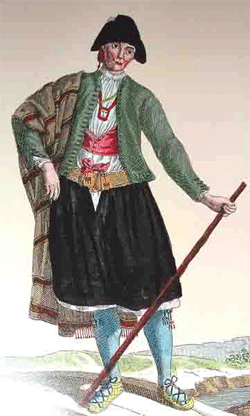
Male suit huertano
 Breeches and calzones:
The breeches are baggy pants.
They are made of linen, usually white or color canvas and never exceed "three fingers" above the knee.
 Pants or trousers:
Costume gala wore pants or shorts, no zaragüel. Normally it was cloth or velvet, and the same color as the jacket.
This luxury pants, covering up to half of the leg. At the lower end had two openings decorated with silver buttons.
 Shirt:
The shirt was a very similar garment to that used today. They could be decorated with tucks, lace or green beans. The color used to be white.
 Belt:
Belt:
an's waist is covered by at least two turns of a strip of fabric, more or less wide, of color. This tissue is fascia.
The strip was used to hold the breeches or trousers, and the shirttail not leave.
 Vest:
Vest:
It is an open garment with flaps, uncrossed. Lacks sleeves. The back was dark, while the front is decorated with silk and vivid colors.
 Jacket:
It is a short jacket to the waist, generally dark colors. The front is adorned with silk braid and lined with trimmings.
 Socks:
The socks were used by women and men, but there are some differences.
Socks man never exceeded the knee, however the woman came to the thigh.
 Flips flops:
If there is a garment that has distinguished social classes in the Region of Murcia are the Flips flops.
They were made from hemp or esparto, and used humble people. It seems that the esparteñas and sandals are the oldest in Spain shoes.
Making of the espadrilles.
Typical recipe Murcia
 Zarangollo:
Ingredients:
Zucchini, green onions, eggs, salt, olive oil
Elaboration:
Courgettes with spring onion chopped and put in a pan with olive oil for frying
when everything becomes tender salt and toss the eggs. Stir the mixture well until set some eggs, and serve warm.